Computex 2026 Warm-up: Nvidia’s $150B Taiwan Infrastructure Pledge and Vera Rubin Chip
Before Computex 2026 officially begins, one announcement has already changed the tone of the global technology conversation.
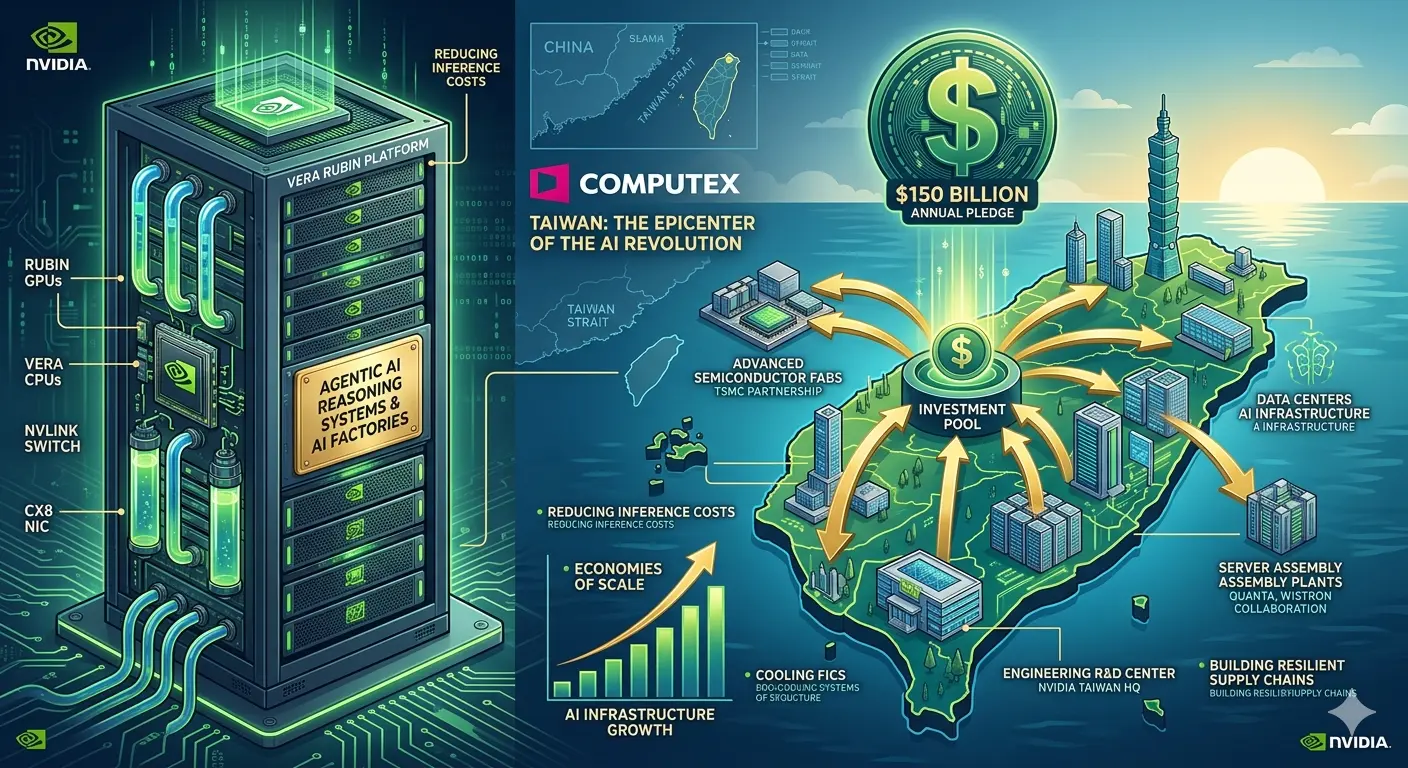
Nvidia CEO Jensen Huang’s statement that the company could spend as much as $150 billion annually across Taiwan’s AI ecosystem is not simply a manufacturing update. It represents a large-scale infrastructure commitment tied directly to the next phase of artificial intelligence deployment.
At the center of that strategy is Nvidia Vera Rubin, the company’s next-generation AI platform designed for large-scale reasoning systems, agentic AI workloads, enterprise inference, and AI factory deployment.
For investors, policymakers, enterprise leaders, and technology operators, the more important question is not whether Vera Rubin is faster than Blackwell.
The bigger question is what happens when one company effectively accelerates the industrialization of AI infrastructure through a supply chain concentrated around a single geographic region.
What Nvidia Actually Announced
In the lead-up to Computex 2026, Nvidia revealed plans to dramatically expand spending throughout Taiwan's semiconductor and AI infrastructure ecosystem.
According to Reuters reporting, Huang described Taiwan as the “epicenter of the AI revolution” and indicated Nvidia’s annual spending could reach approximately $150 billion through manufacturing, packaging, server production, infrastructure partnerships, and ecosystem development. This represents a significant increase from spending levels reported just a few years ago. :contentReference[oaicite:0]{index=0}
The investment spans multiple layers:
- Advanced semiconductor fabrication
- AI server manufacturing
- Packaging and testing facilities
- Networking infrastructure
- Cooling and power systems
- Enterprise AI deployment ecosystems
- Research and engineering expansion
At the same time, Nvidia is expanding its physical footprint in Taiwan through a new headquarters initiative and deeper collaboration with suppliers such as :contentReference[oaicite:1]{index=1}, :contentReference[oaicite:2]{index=2}, Quanta, and Wistron. :contentReference[oaicite:3]{index=3}
Viewed through a business lens, this is less about chips and more about creating a vertically integrated AI infrastructure ecosystem.
Definition: What Is the Nvidia Vera Rubin Platform?
Vera Rubin is Nvidia’s next-generation AI computing platform that combines Vera CPUs, Rubin GPUs, high-bandwidth networking, advanced memory architecture, and rack-scale infrastructure into a unified AI system designed for training and inference at massive scale.
Unlike previous generations that focused primarily on GPU performance improvements, Vera Rubin is positioned as a complete AI factory architecture.
The system is intended to support:
- Agentic AI systems
- Reasoning models
- Multi-agent workflows
- Large-scale enterprise AI deployments
- Sovereign AI initiatives
- Scientific computing
- Advanced robotics platforms
According to Nvidia disclosures around Computex and GTC Taipei, a Vera Rubin NVL72 rack integrates 72 Rubin GPUs and 36 Vera CPUs while targeting major gains in inference efficiency and performance-per-watt. :contentReference[oaicite:4]{index=4}
Why Vera Rubin Matters More Than Another GPU Upgrade
Most technology coverage focuses on benchmark numbers.
But enterprise buyers increasingly care about economics rather than raw performance.
AI adoption has entered a phase where operational cost matters almost as much as model capability.
According to McKinsey, generative AI could contribute between $2.6 trillion and $4.4 trillion annually to the global economy. Yet many organizations still struggle to achieve positive ROI from AI deployments because infrastructure costs remain extremely high.
That is where Vera Rubin becomes strategically important.
If Nvidia successfully reduces inference costs while improving throughput, AI deployments that previously looked economically questionable may become commercially viable.
This changes procurement decisions across industries.
Healthcare systems, financial institutions, logistics operators, manufacturers, and governments all evaluate AI adoption through cost-per-outcome calculations.
A significant reduction in inference expense could move AI from experimental budgets into core operational spending.
The Real Economic Story Behind the $150 Billion Figure
The headline number attracts attention because it exceeds the annual GDP of many countries.
But the deeper signal is capital allocation.
Nvidia is effectively betting that AI infrastructure demand will continue growing for years rather than quarters.
Historically, large technology spending cycles followed a predictable pattern:
- PC infrastructure
- Internet infrastructure
- Cloud infrastructure
- Mobile infrastructure
- AI infrastructure
Each phase required billions in hardware, networking, software, training, and ecosystem development.
The AI cycle appears to be following a similar trajectory, except at a larger scale due to compute requirements.
According to Gartner forecasts, enterprise AI spending continues to expand across infrastructure, applications, and operational transformation initiatives. Multiple consulting firms now classify AI investment as a board-level strategic priority rather than a departmental technology project.
Infrastructure Is Becoming the New Competitive Moat
One misconception surrounding AI is that models alone create competitive advantage.
Increasingly, infrastructure appears to be the differentiator.
The companies winning in AI are not necessarily those building the smartest models.
They are often the organizations capable of operating AI systems reliably at scale.
That requires:
- Compute capacity
- Networking
- Power availability
- Cooling infrastructure
- Data pipelines
- Security architecture
- Governance frameworks
Nvidia’s Taiwan strategy strengthens nearly every layer of that stack.
How Enterprise Teams Experience This Shift
In real enterprise workflows, teams notice a recurring problem long before executives do.
The challenge is rarely model quality. The challenge is operational consistency. AI pilots often perform well during demonstrations but become expensive, slow, and difficult to scale once hundreds or thousands of employees begin using them simultaneously.
Infrastructure limitations quickly become visible through latency issues, rising cloud bills, and unpredictable workload spikes. This is why hardware efficiency improvements matter far more than many AI headlines suggest.
One issue that keeps resurfacing is procurement timing. Organizations spend months evaluating AI software while underestimating infrastructure readiness. Then deployment deadlines arrive and internal teams discover networking, storage, governance, and compute capacity were never designed for AI-scale workloads.
That operational gap is precisely where Nvidia is positioning Vera Rubin and its broader ecosystem strategy.
AI Workforce Implications
The workforce impact of AI infrastructure expansion receives less attention than model releases.
Yet it may be the more important long-term story.
According to the World Economic Forum Future of Jobs Report, AI adoption will simultaneously eliminate certain task categories while creating demand for new technical, operational, and governance roles.
Infrastructure-heavy AI deployment increases demand for:
- AI platform engineers
- MLOps specialists
- Data infrastructure architects
- AI governance professionals
- Cybersecurity teams
- Energy and cooling specialists
- Data center operations personnel
Rather than replacing entire professions overnight, AI adoption often redistributes work across organizations.
The winners are typically companies that retrain existing teams instead of assuming automation alone will solve productivity challenges.
Board-Level Questions Emerging From Computex 2026
Leadership teams evaluating AI investments increasingly focus on questions that extend beyond technology.
| Board Question | Strategic Concern |
|---|---|
| Can AI improve margins? | Infrastructure ROI |
| Is our supply chain resilient? | Geopolitical concentration |
| Do we have AI talent? | Workforce readiness |
| How much compute will we need? | Long-term capacity planning |
| Can we govern AI safely? | Compliance and risk management |
| Are competitors moving faster? | Market positioning |
Nvidia’s Taiwan expansion places all of these questions into sharper focus.
Where This Breaks Down in Real Use
Large infrastructure investments create optimism, but operational reality tends to be more complicated.
This sounds efficient, but in practice many organizations are still struggling with foundational digital transformation projects. Some companies have not modernized core systems, cleaned enterprise data, or established governance standards.
Adding advanced AI infrastructure does not automatically solve those issues.
Several practical friction points remain:
- Budget constraints outside large enterprises
- Data quality problems
- AI governance uncertainty
- Power and cooling limitations
- Shortage of experienced AI operators
- Regulatory variation across regions
- Vendor concentration risk
When leadership teams evaluate this reality, the conversation often shifts from technological possibility to operational readiness.
And that distinction matters.
Organizations that underestimate implementation complexity frequently experience slower returns than expected.
The Geopolitical Layer Nobody Can Ignore
Taiwan already sits at the center of advanced semiconductor production.
Nvidia’s increased dependence on Taiwan reinforces a concentration trend that governments have been attempting to reduce through domestic manufacturing initiatives.
The challenge is scale.
Taiwan's semiconductor ecosystem has decades of accumulated expertise, supplier relationships, logistics infrastructure, and manufacturing knowledge.
Replicating that ecosystem elsewhere is possible, but not quickly.
This creates strategic tension between efficiency and resilience.
Businesses generally prefer efficiency.
Governments often prioritize resilience.
The next decade will likely involve balancing both objectives.
How Vera Rubin Compares With Earlier AI Infrastructure Generations
- Hopper: Established Nvidia’s dominance in large-scale AI training.
- Blackwell: Focused on scaling generative AI and enterprise deployment.
- Vera Rubin: Focuses on reasoning systems, AI factories, efficiency, and rack-scale integration.
The progression suggests Nvidia is evolving from chip provider to infrastructure orchestrator.
That strategic shift may ultimately prove more important than any benchmark score released during Computex.
Who Should NOT Use This Approach
Not every organization benefits from aggressive AI infrastructure adoption.
- Small businesses with limited digital maturity
- Companies lacking reliable data systems
- Organizations without clear AI use cases
- Teams pursuing AI primarily because competitors are doing it
- Businesses that cannot support governance requirements
For these groups, waiting, observing, and building stronger operational foundations may produce better outcomes than rushing into large-scale AI deployments.
Key Takeaways for Enterprise Leaders
- Vera Rubin represents a platform strategy, not just a chip launch.
- Nvidia’s Taiwan investment signals confidence in long-term AI demand.
- Infrastructure is becoming a primary source of competitive advantage.
- Workforce readiness remains as important as technology readiness.
- AI economics increasingly depend on efficiency rather than raw performance.
- Geopolitical concentration remains an unresolved strategic risk.
Suggested Internal Links
- enterprise AI governance frameworks
- future of white-collar work
- AI-driven productivity shifts
- AI infrastructure investment trends
- enterprise data modernization strategies
- sovereign AI development models
Further Reading and Authority Mentions
- McKinsey Global Institute
- World Economic Forum
- Stanford Human-Centered AI Institute
- Harvard Business Review
- OECD AI Policy Observatory
- Gartner
FAQs
What is Nvidia Vera Rubin?
Vera Rubin is Nvidia’s next-generation AI platform combining CPUs, GPUs, networking, and rack-scale infrastructure designed for large-scale AI workloads.
Why is Nvidia investing heavily in Taiwan?
Taiwan hosts one of the world’s most advanced semiconductor ecosystems, including manufacturing, packaging, server assembly, and supply chain capabilities essential for AI infrastructure.
How large is Nvidia’s planned Taiwan spending?
Public statements ahead of Computex 2026 indicate spending could reach approximately $150 billion annually across Taiwan’s AI ecosystem. :contentReference[oaicite:5]{index=5}
Will Vera Rubin replace Blackwell?
Vera Rubin is positioned as the next major generation following Blackwell, offering higher efficiency and infrastructure-level improvements for AI deployments.
Does this mean AI adoption will become cheaper?
Potentially. Nvidia is emphasizing efficiency and lower inference costs, though actual savings depend on implementation, workload type, and deployment scale.
What industries could benefit most?
Healthcare, financial services, manufacturing, logistics, telecommunications, government, and scientific research are among the sectors likely to benefit from large-scale AI infrastructure improvements.
What is the biggest risk in this strategy?
Supply chain concentration remains one of the largest risks, particularly given Taiwan’s strategic importance to advanced semiconductor production.
The most interesting aspect of Computex 2026 may not be the chip itself.
It may be the growing realization that AI is entering the same category as electricity, cloud computing, and broadband infrastructure: a foundational capability that reshapes industries slowly at first and then all at once.
For organizations watching this transition, the next step is not chasing every announcement. It is understanding where infrastructure, workforce readiness, and business strategy intersect before the next investment cycle accelerates.
Disclaimer: This article is for informational and educational purposes only and should not be considered investment, financial, or legal advice.