The Agent Leap: How Multi-Agent Orchestration Platforms Are Reshaping Enterprise Work
The conversation around artificial intelligence is moving beyond chatbots and standalone assistants. A growing number of organizations are now exploring what many technology leaders call the Agent Leap: the transition from single-purpose AI tools toward coordinated networks of AI agents capable of collaborating on complex business processes.
This shift is attracting attention because enterprises are discovering that productivity gains rarely come from isolated automation. Real value often emerges when multiple systems can plan, delegate, verify, execute, and report across an entire workflow.
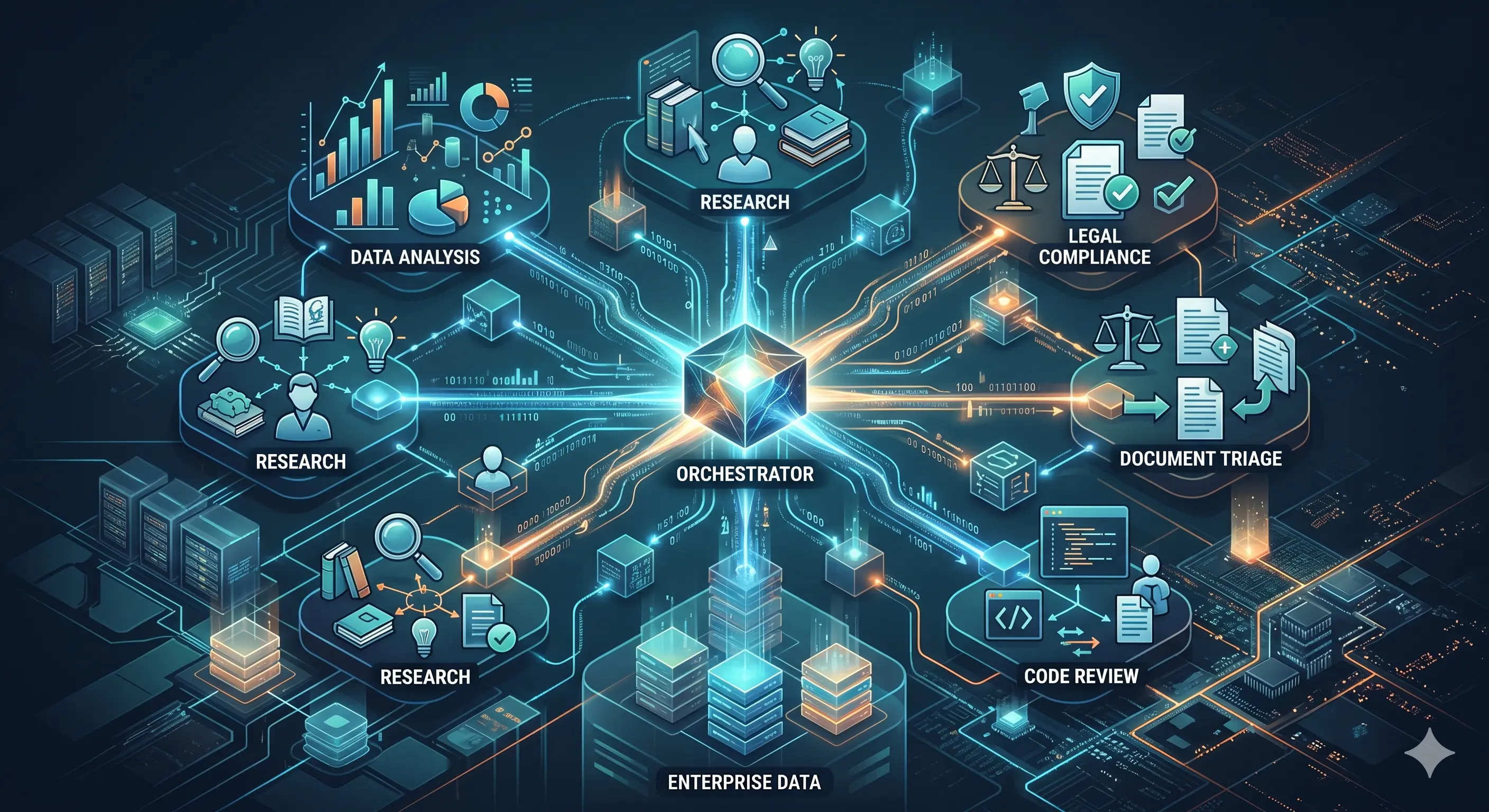
Multi-agent orchestration platforms are increasingly positioned as the infrastructure layer enabling that transformation. Rather than asking one model to perform every task, organizations deploy specialized agents that coordinate with one another under defined governance rules.
While the concept sounds futuristic, many large enterprises are already experimenting with agent-based architectures in customer service, software development, legal operations, procurement, finance, cybersecurity, and knowledge management.
The important question is not whether AI agents will become more capable. The more significant question is whether organizations can operationalize them responsibly, economically, and at scale.
What Is the Agent Leap?
Definition: The Agent Leap refers to the transition from isolated AI assistants toward interconnected systems of specialized AI agents that collaborate to complete multi-step business objectives under human supervision and governance controls.
Traditional AI implementations typically involve a single model responding to user prompts. Multi-agent systems introduce additional layers of specialization.
- A planning agent defines objectives.
- A research agent gathers information.
- An execution agent performs actions.
- A compliance agent validates outputs.
- A reporting agent summarizes results.
Instead of one model attempting to solve everything, work becomes distributed across coordinated digital workers.
This mirrors how organizations themselves operate. Human teams rarely consist of one person doing every task. Departments divide responsibilities according to expertise. Multi-agent architectures attempt to replicate that operational model in software.
Why Enterprises Are Paying Attention
According to McKinsey, generative AI could contribute between $2.6 trillion and $4.4 trillion annually to the global economy through productivity improvements and new business capabilities. However, achieving those gains requires moving beyond simple chatbot deployments.
Many organizations have already learned that productivity bottlenecks exist between systems rather than within individual tasks. A chatbot may draft an email effectively, but business processes often require approvals, compliance checks, document retrieval, CRM updates, workflow routing, and reporting.
Multi-agent orchestration addresses this coordination challenge.
According to the World Economic Forum Future of Jobs research, organizations increasingly expect AI-driven workflow redesign to become a major source of operational efficiency over the next decade. Agent-based systems fit directly into that trend.
The Architecture Behind Multi-Agent Orchestration Platforms
Most orchestration platforms follow a similar structure.
1. Task Intake Layer
A business request enters the system through a user interface, API, workflow trigger, or enterprise application.
2. Planning Agent
The planning layer breaks a goal into smaller executable tasks.
3. Specialist Agents
Individual agents perform specific functions such as research, analysis, coding, compliance validation, customer interaction, or document review.
4. Verification Layer
Outputs are evaluated against business rules, governance policies, and quality standards.
5. Human Oversight Layer
Critical decisions remain subject to human review.
6. Monitoring and Audit Layer
Every action is logged for compliance, security, and performance measurement.
This structure allows organizations to maintain accountability while benefiting from automation.
Anthropic's Legal AI Tool and the Rise of Specialized Enterprise Agents
One of the most interesting developments in enterprise AI is the emergence of specialized legal agents.
Anthropic has increasingly positioned its Claude models for enterprise knowledge work, including legal analysis, contract review, document interpretation, policy analysis, and research-intensive workflows.
Rather than functioning as a simple chatbot, legal AI systems are evolving toward agentic workflows capable of handling multiple stages of legal operations.
How Anthropic's Legal AI Workflow Operates
The process generally follows several steps.
- A legal document enters the system.
- The AI identifies document structure and clauses.
- The system extracts key obligations and risks.
- Specialized review agents compare clauses against company policies.
- Compliance checks are performed.
- Potential issues are flagged for legal professionals.
- A summary report is generated.
- Human counsel reviews recommendations.
The final decision remains with attorneys, but significant portions of repetitive analysis can be accelerated.
Real Enterprise Use Case
A procurement department reviewing hundreds of vendor contracts each quarter may traditionally require multiple legal professionals to identify liability clauses, data privacy provisions, indemnification language, and renewal terms.
With an agentic workflow, AI systems can perform the first-pass review, classify documents, identify deviations from approved language, and prepare risk summaries before human evaluation begins.
The result is not necessarily fewer lawyers. In many organizations, the result is faster throughput and greater focus on higher-value legal judgment.
Traditional Legal Review vs Agent-Based Legal Review
| Factor | Traditional Process | Agent-Based Process |
|---|---|---|
| Document Intake | Manual | Automated |
| Clause Identification | Human Review | AI-Assisted |
| Policy Comparison | Manual Cross-Checking | Automated Validation |
| Reporting | Manual Preparation | Automated Drafting |
| Escalation | Human Driven | Risk-Based Routing |
| Final Approval | Human | Human |
How Multi-Agent Systems Differ from Earlier AI Tools
Earlier generations of enterprise AI largely focused on prediction, classification, or conversational interfaces.
Multi-agent systems introduce a new capability: coordination.
The distinction is important.
- Chatbots answer questions.
- Assistants generate content.
- Agents execute tasks.
- Multi-agent systems manage processes.
This progression explains why enterprise leaders increasingly view orchestration as the next layer of AI maturity.
What Teams Notice During Real Deployments
In real enterprise workflows, teams notice that the biggest obstacle is rarely model intelligence. More often, the challenge is integrating agents with existing business processes, governance requirements, and legacy software environments.
Organizations frequently discover that a highly capable AI agent cannot deliver value if critical business information remains trapped inside disconnected systems. Data access becomes as important as model performance.
One issue that keeps resurfacing is process ambiguity. Human employees often rely on informal knowledge, undocumented exceptions, and tribal expertise. When organizations attempt to automate those workflows, they realize many processes were never clearly defined in the first place.
This sounds efficient, but in practice successful deployments often involve extensive process redesign before any automation benefits become visible. The technology receives attention, but workflow engineering usually determines success or failure.
The Economic Case for Agent Orchestration
Enterprise spending on AI continues to rise rapidly. Gartner has projected significant growth in AI-related software investments, while major cloud providers continue allocating billions toward AI infrastructure.
From a boardroom perspective, the appeal is straightforward.
- Reduced operational friction.
- Faster decision cycles.
- Improved knowledge retrieval.
- Higher employee productivity.
- More scalable business operations.
However, productivity gains rarely appear immediately.
The highest-performing organizations typically invest simultaneously in governance, training, workflow redesign, change management, and measurement frameworks.
Workforce Implications: Evolution Rather Than Replacement
The workforce discussion surrounding AI often becomes polarized. Some predict widespread job displacement. Others argue that AI simply enhances productivity.
Reality is likely more nuanced.
According to research from organizations including OECD, Stanford HAI, and the World Economic Forum, many occupations will experience task transformation rather than full automation.
Multi-agent systems are particularly likely to reshape knowledge work.
- Legal professionals may review more contracts.
- Analysts may oversee larger information flows.
- Managers may supervise digital workers.
- Engineers may orchestrate AI systems rather than manually perform every task.
The emerging skill set increasingly combines domain expertise with AI supervision capabilities.
Where This Breaks Down in Real Use
Despite the enthusiasm, agent orchestration faces substantial challenges.
Implementation Complexity
Organizations frequently underestimate integration requirements. Connecting agents to enterprise systems can require significant engineering effort.
Budget Misalignment
When leadership teams evaluate AI initiatives, expectations often exceed operational reality. Executives may expect immediate productivity gains while transformation projects require months of process redesign.
Cultural Resistance
Employees may resist systems perceived as replacing expertise or reducing autonomy.
Governance Gaps
Without strong oversight, organizations risk inconsistent outputs, compliance issues, and accountability concerns.
Over-Automation
Not every process should be automated. Excessive automation can reduce flexibility, increase systemic risk, and create operational fragility.
Research published by Harvard Business Review and Stanford HAI consistently highlights the importance of maintaining human oversight in high-impact decisions.
Pros and Cons of Multi-Agent Orchestration Platforms
Advantages
- Scalable workflow automation.
- Improved process consistency.
- Reduced administrative burden.
- Better knowledge management.
- Faster execution cycles.
- Enhanced operational visibility.
Limitations
- Complex implementation.
- High governance requirements.
- Integration challenges.
- Data quality dependencies.
- Security concerns.
- Ongoing monitoring costs.
Who Should NOT Use This
Not every organization needs multi-agent orchestration today.
- Very small teams with simple workflows.
- Organizations lacking documented processes.
- Businesses with poor data governance.
- Teams seeking immediate cost reductions without transformation investment.
- Companies still evaluating basic AI adoption.
In these situations, simpler automation solutions may provide better returns.
Data Summary: The Current State of the Agent Leap
- Enterprise AI spending continues to accelerate.
- Agent-based workflows are moving from experimentation to operational pilots.
- Legal, customer service, and software engineering are leading adoption categories.
- Governance remains one of the largest barriers to scale.
- Workforce transformation is proving more significant than workforce replacement.
- Multi-agent coordination is emerging as a key differentiator in enterprise AI strategy.
Internal Linking Opportunities
- enterprise AI governance frameworks
- future of white-collar work
- AI-driven productivity shifts
- enterprise automation strategy
- responsible AI implementation
- generative AI economics
Authority Sources Worth Referencing
- McKinsey
- World Economic Forum
- Harvard Business Review
- Stanford HAI
- OECD
- Gartner
Frequently Asked Questions
What is a multi-agent orchestration platform?
A multi-agent orchestration platform coordinates multiple AI agents that collaborate to complete complex workflows under defined governance and supervision rules.
How is an AI agent different from a chatbot?
Chatbots primarily respond to prompts, while agents can plan tasks, perform actions, interact with systems, and execute workflows.
Why are enterprises interested in agentic AI?
Organizations are pursuing higher productivity, improved process automation, and more scalable knowledge work.
Can multi-agent systems replace employees?
Most current evidence suggests task transformation is more common than complete job replacement.
Are legal AI tools replacing lawyers?
No. Current legal AI systems primarily assist with research, review, and analysis while human professionals remain responsible for judgment and final decisions.
What is the biggest implementation challenge?
Integration with existing systems and governance processes remains one of the most significant barriers.
What industries are adopting agentic AI fastest?
Technology, financial services, legal services, consulting, customer support, and enterprise operations are among the leading adopters.
A Practical Reflection on the Agent Leap
The most interesting aspect of multi-agent orchestration is not the technology itself. It is the organizational question beneath it.
For decades, businesses optimized human workflows around software systems. The Agent Leap suggests a reversal may be underway, where software increasingly adapts to business objectives through coordinated digital agents.
Whether this becomes a lasting productivity revolution or another cycle of technology overexpectation will depend less on model capabilities and more on governance, leadership discipline, workforce adaptation, and thoughtful implementation.
The organizations that benefit most are unlikely to be the ones deploying the most agents. They will likely be the ones that understand where automation genuinely creates value, where human judgment remains essential, and how to combine both effectively.
Disclaimer: This article is provided for informational and educational purposes only. It does not constitute legal, financial, investment, or professional advice. Organizations should evaluate AI adoption strategies according to their own operational, regulatory, and governance requirements.