Google AI Threat Defense: The New Enterprise Security Arms Race
Artificial intelligence is no longer just a productivity tool. It has become a security layer, a governance challenge, a workforce issue, and increasingly, a board-level risk category.
That is the context behind Google AI Threat Defense. While many organizations spent the last two years experimenting with generative AI for content creation, coding assistance, and workflow automation, attackers were doing something similar. They were using AI to identify vulnerabilities faster, automate reconnaissance, generate phishing campaigns, and exploit security gaps at a scale that traditional security operations were never designed to handle.
Google's response is not simply another cybersecurity product. It represents a broader shift in how enterprise defense systems are being redesigned for an AI-native threat environment.
And that shift has implications far beyond cybersecurity teams.
What Is Google AI Threat Defense?
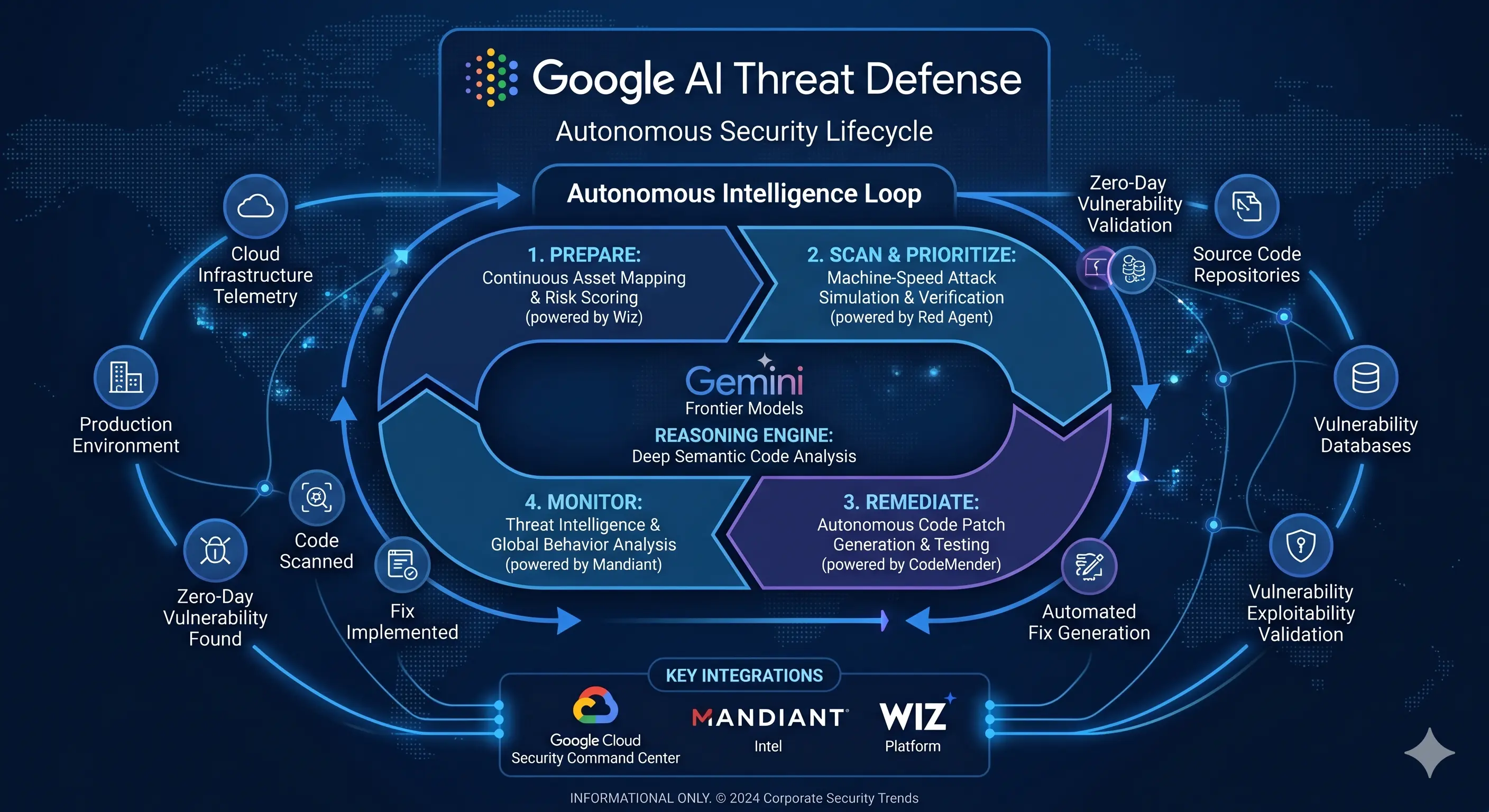
Definition: Google AI Threat Defense is an enterprise cybersecurity framework that combines artificial intelligence models, cloud security visibility, threat intelligence, vulnerability management, and automated remediation systems to identify, prioritize, and respond to cyber threats in real time.
The platform combines several major Google security assets, including Gemini, Mandiant, Wiz integration capabilities, and AI-assisted vulnerability management workflows.
The goal is relatively straightforward.
If attackers can use AI to discover weaknesses faster than human security teams, defenders need systems capable of operating at similar speed.
This creates a machine-versus-machine security environment where AI increasingly participates in both attack and defense operations.
Why Google Is Investing So Aggressively in AI Defense
The economics are changing.
Traditional security operations centers depend heavily on analysts manually reviewing alerts, triaging incidents, investigating vulnerabilities, and coordinating response efforts.
That model already struggled before generative AI arrived.
Now organizations face:
- AI-generated phishing campaigns
- Automated vulnerability discovery
- Rapid malware adaptation
- Synthetic identity attacks
- Large-scale social engineering operations
- AI-assisted software exploitation
According to Stanford HAI's 2025 AI Index, enterprise AI adoption continues accelerating across industries while AI capabilities improve rapidly across reasoning, coding, and automation benchmarks. That creates new productivity opportunities but also expands attack surfaces significantly.
The challenge is no longer simply detecting threats.
The challenge is determining which threats actually matter before attackers exploit them.
How Google AI Threat Defense Works
Most enterprise security systems generate enormous volumes of alerts.
One recurring problem is that security teams spend time investigating issues that ultimately pose little practical risk.
Google's approach attempts to reduce that burden.
Step 1: Infrastructure Mapping
The platform analyzes cloud environments, applications, APIs, identities, containers, workloads, and network assets.
This creates a continuously updated map of enterprise exposure.
Rather than looking at isolated vulnerabilities, the system evaluates how systems connect and interact.
Step 2: AI-Powered Vulnerability Analysis
Gemini and related AI models evaluate security weaknesses.
The objective is not simply finding vulnerabilities.
The objective is understanding exploitability.
For example, a vulnerability may technically exist but remain inaccessible from the internet. Another vulnerability may provide direct access to sensitive customer data.
The second issue becomes a higher priority.
Step 3: Threat Intelligence Correlation
Mandiant threat intelligence data helps connect vulnerabilities with active attack campaigns.
This adds operational context.
If threat actors are actively exploiting a particular weakness, response urgency increases dramatically.
Step 4: Automated Remediation
AI-assisted systems can suggest fixes, generate patches, recommend configuration changes, and validate potential solutions.
Developers receive actionable recommendations instead of generic security alerts.
Step 5: Continuous Monitoring
After remediation, systems continue monitoring environments for regression, new exposures, or emerging attack patterns.
The process becomes cyclical rather than reactive.
Traditional Security Operations vs Google AI Threat Defense
| Area | Traditional Workflow | AI Threat Defense Approach |
|---|---|---|
| Threat Detection | Rule-based monitoring | AI-assisted anomaly detection |
| Vulnerability Review | Manual prioritization | Automated risk ranking |
| Investigation Speed | Hours or days | Near real-time analysis |
| Patch Recommendations | Human research | AI-generated remediation guidance |
| Threat Intelligence | Separate security feeds | Integrated intelligence workflows |
| Monitoring | Periodic reviews | Continuous assessment |
Real Enterprise Use Cases
In real enterprise workflows, teams notice that the biggest problem is rarely a lack of alerts.
It is alert overload.
Large organizations often receive thousands of security events every day. Security teams quickly learn that most alerts are noise, but determining which ones deserve attention consumes substantial resources.
AI-based prioritization addresses this operational bottleneck directly.
A multinational financial institution, for example, may operate thousands of applications across multiple cloud providers. Traditional vulnerability scans might identify hundreds of thousands of findings.
Security leadership cannot realistically address every issue simultaneously.
AI threat defense systems help identify which vulnerabilities create actual business exposure.
That prioritization changes resource allocation decisions.
Healthcare Systems
Hospitals increasingly depend on interconnected digital systems.
AI threat defense can monitor access patterns, detect anomalies, and flag suspicious behavior before attackers reach critical systems.
Software Development Teams
Development teams often move faster than security reviews.
AI-assisted remediation helps developers address vulnerabilities during software delivery instead of waiting for lengthy security audits.
Critical Infrastructure
Governments and infrastructure operators face growing pressure to defend energy grids, transportation systems, telecommunications networks, and public services.
Recent initiatives from organizations like GCHQ highlight how national security agencies are increasingly integrating AI into cyber defense operations.
The Workforce Implications Nobody Can Ignore
Discussions around AI security frequently focus on technology.
The workforce impact receives less attention.
But it may ultimately become the larger story.
According to the World Economic Forum Future of Jobs Report 2025, AI and information processing technologies are expected to create approximately 11 million jobs while displacing around 9 million jobs by 2030.
The broader labor market transformation is even larger, affecting hundreds of millions of workers globally.
The interesting detail is where the changes occur.
Security analysts are unlikely to disappear.
Routine security work, however, becomes increasingly automated.
That changes hiring requirements.
Organizations may need fewer junior analysts performing repetitive investigations and more senior personnel capable of managing AI-driven security systems.
One issue that keeps resurfacing is the shrinking pathway for entry-level talent. Many organizations historically trained future security leaders through manual analyst roles. When automation absorbs those responsibilities, workforce development becomes more complicated.
Where This Breaks Down in Real Use
AI threat defense sounds efficient.
But implementation rarely looks as smooth as vendor presentations suggest.
Data Quality Problems
AI systems depend heavily on accurate infrastructure visibility.
Many enterprises still struggle with incomplete asset inventories, fragmented cloud environments, and inconsistent security controls.
Poor visibility reduces AI effectiveness.
Budget Misalignment
When leadership teams evaluate this technology, they often expect immediate cost reductions.
That assumption creates problems.
Most organizations require significant investments in cloud infrastructure, governance frameworks, integration projects, and employee training before realizing measurable security gains.
Cultural Resistance
Security teams sometimes distrust automated recommendations.
And for understandable reasons.
False positives, hallucinated recommendations, or incomplete remediation guidance can create operational risk.
Trust develops gradually.
Over-Automation Risks
This sounds efficient, but in practice fully automated remediation introduces new vulnerabilities.
Incorrect patches, unintended service disruptions, or automated configuration changes can create business continuity issues.
Human oversight remains essential.
Governance Complexity
AI security decisions increasingly affect regulatory compliance, audit readiness, privacy requirements, and enterprise risk management.
That expands security discussions beyond technical teams.
Boards, legal departments, and compliance officers become active stakeholders.
Comparison With Other AI Security Platforms
Google is not operating alone.
Several major players are pursuing similar strategies.
- Microsoft Security Copilot focuses heavily on AI-assisted security operations.
- CrowdStrike integrates AI into endpoint detection and threat intelligence workflows.
- Palo Alto Networks continues expanding AI-driven threat detection capabilities.
- SentinelOne emphasizes autonomous security operations.
- IBM integrates generative AI into enterprise security management.
The differentiator for Google appears to be ecosystem integration.
By combining Gemini, Mandiant intelligence, cloud infrastructure visibility, and vulnerability management, Google is attempting to build a unified security workflow rather than a standalone AI assistant.
Hype Versus Reality
The cybersecurity industry has a history of overpromising automation.
AI threat defense should be evaluated carefully.
It is not a replacement for security professionals.
It is not a guarantee against breaches.
It is not an instant solution for governance problems.
What it offers is operational acceleration.
Organizations capable of integrating AI responsibly may improve response times, prioritize risks more effectively, and reduce analyst workload.
Organizations expecting autonomous security without human expertise will likely be disappointed.
Who Should NOT Use This
Not every organization benefits equally.
- Small businesses with minimal digital infrastructure may gain limited value.
- Companies lacking basic cybersecurity practices should address foundational security gaps first.
- Organizations without dedicated security personnel may struggle to interpret AI-generated recommendations.
- Teams seeking immediate cost reduction rather than long-term resilience may find implementation difficult to justify.
For some businesses, improving asset management, access controls, and employee training may deliver greater security returns than advanced AI systems.
Board-Level Economic Implications
The broader significance of Google AI Threat Defense extends beyond cybersecurity.
It reflects how enterprise software spending is evolving.
According to McKinsey research, generative AI could contribute between $2.6 trillion and $4.4 trillion annually across global industries. Much of that value depends on organizations trusting AI systems enough to integrate them into critical operations.
Trust requires security.
Security requires new infrastructure.
And that infrastructure increasingly includes AI itself.
This creates a self-reinforcing investment cycle.
Organizations adopt AI.
AI expands attack surfaces.
Expanded attack surfaces require AI-based defenses.
Defensive AI becomes another strategic spending category.
That cycle is likely to shape enterprise technology budgets throughout the next decade.
Internal Linking Opportunities
- enterprise AI governance frameworks
- future of white-collar work
- AI-driven productivity shifts
- cybersecurity risk management strategies
- generative AI implementation roadmap
- AI compliance and governance challenges
Authority Mentions
- McKinsey & Company
- World Economic Forum
- Stanford Human-Centered AI Institute (HAI)
- Harvard Business Review
- OECD
- Gartner
Frequently Asked Questions
Is Google AI Threat Defense a standalone product?
It functions more as an integrated security framework that combines multiple Google security capabilities, including AI models, threat intelligence, cloud visibility, and remediation workflows.
Does AI Threat Defense replace cybersecurity teams?
No. It automates portions of analysis and prioritization but still requires human oversight, governance, and decision-making.
Can small businesses benefit from it?
Some can, but the strongest value proposition exists for organizations managing large-scale cloud infrastructure and complex digital environments.
How is it different from traditional vulnerability scanning?
Traditional scanners identify weaknesses. AI threat defense attempts to determine which weaknesses are actually exploitable and business-critical.
What industries are adopting AI security fastest?
Financial services, healthcare, technology, telecommunications, and critical infrastructure sectors currently show the highest levels of adoption.
Does AI create new security risks?
Yes. AI systems introduce risks related to model misuse, prompt injection, data exposure, and automated exploitation techniques.
Will AI security spending continue growing?
Current enterprise investment trends suggest security will remain one of the fastest-growing segments of AI-related spending over the coming years.
The larger lesson is not that AI will solve cybersecurity.
It is that cybersecurity itself is becoming an AI discipline. Organizations that understand that distinction early will likely make better decisions about investment, workforce development, governance, and risk management. The most useful next step is not rushing toward automation, but evaluating where human judgment and machine-scale analysis genuinely complement each other.
Disclaimer: This article is for informational and educational purposes only and should not be considered legal, cybersecurity, financial, or investment advice.