Apple's Massive Spring Hardware Leak: Separating Hype from Reality on the iPhone 17e & The Fold
And just like that, the tech world is scrambling again. For the last few years, smartphone updates have felt like a gentle cruise control. A slightly better camera here, a marginally faster chip there. But the latest spring supply chain leaks suggest Apple is finally ripping up the script.
If the rumors from overseas assembly lines hold true, we aren't just looking at the standard September cycle. We are looking at a fundamental shift in Apple's hardware lineup featuring the heavily debated iPhone 17e (often referred to as the 'Air' or 'Slim') and fresh, concrete movements on the elusive Apple foldable.
So, let's look at what the supply chain is actually saying, strip away the ridiculous fan-renders, and talk about how these devices actually fit into daily professional workflows.
The iPhone 17e: A Diet Pro or a Glorified Standard Model?
The biggest leak causing waves right now is the iPhone 17e. Initially, industry insiders called this the iPhone 17 Slim, but '17e' seems to be the moniker sticking in recent manufacturing manifests. Think of it as the spiritual successor to the iPhone X—a device meant to bridge the gap between standard and premium, but primarily focused on a dramatic redesign rather than raw power.
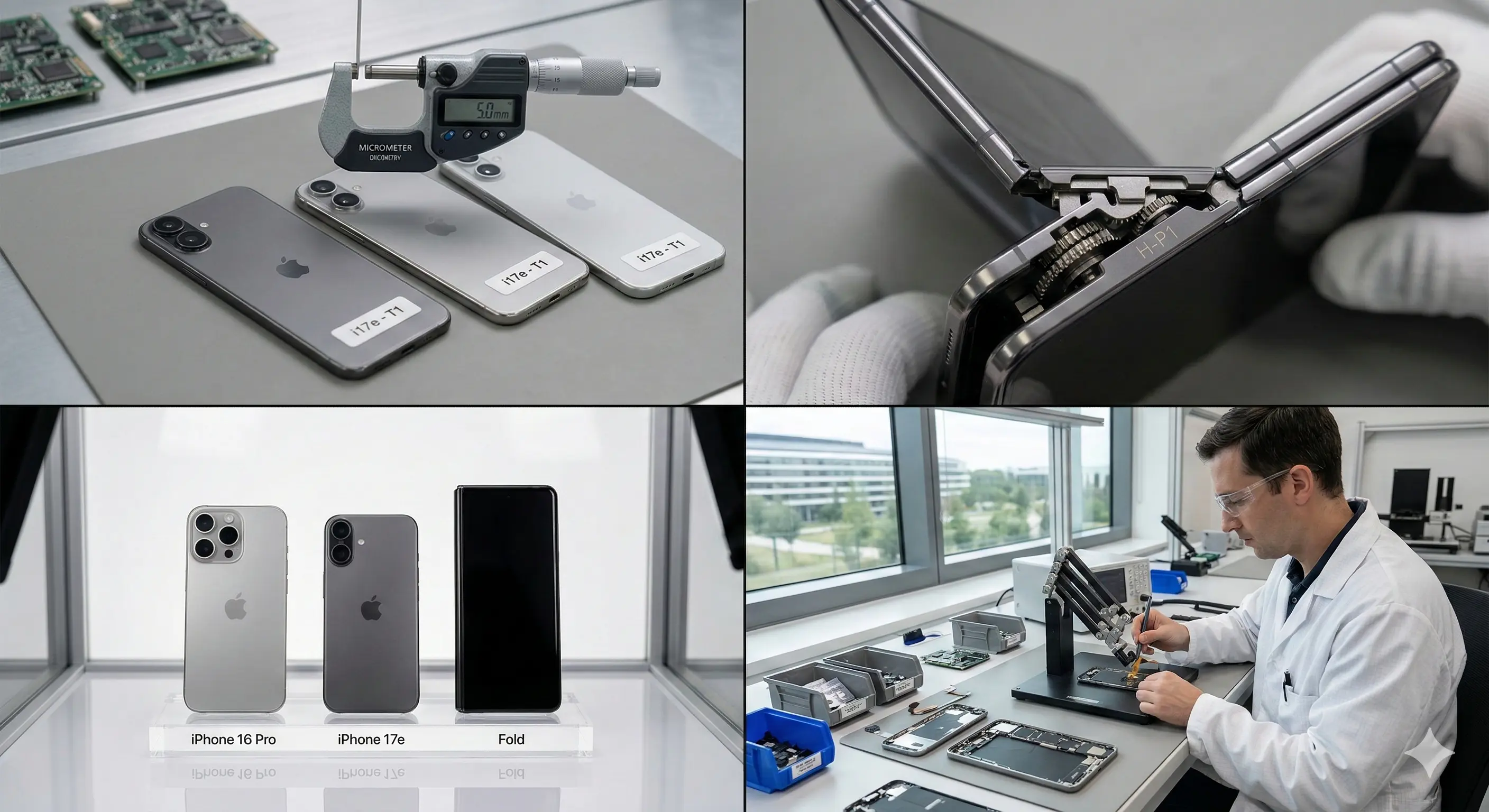
We are hearing dimensions that put this phone at roughly 5mm thick. To put that in perspective, the iPhone 15 Pro sits at 8.25mm. Shaving off over 3mm is a massive engineering hurdle. It requires an entirely redesigned logic board and a fundamentally different battery chemistry, likely moving toward higher-density silicon-carbon cells to maintain any semblance of an all-day charge.
But here is the catch. The leaks suggest a starting price of around $1,299. That makes it more expensive than a Pro Max, but reportedly, it will only feature a single rear camera and an A19 chip (not the A19 Pro). It is a status symbol device, prioritizing form over maximum utility.
Where This Breaks Down in Real Use
It is easy to get caught up in the aesthetics of a hyper-thin device. A 5mm phone sounds efficient, but in practice, physics always wins.
One issue that keeps coming up is thermal throttling. When you pack a high-performance neural engine into a chassis with virtually no cooling mass, the device gets hot quickly. If you are shooting 4K ProRes video or multitasking between heavy enterprise apps, the phone will likely dim the screen and throttle the processor within minutes to save itself from overheating.
If you are a power user who works out of an airport lounge, tethering your laptop to your phone's hotspot while taking a Zoom call, an ultra-thin battery and compromised thermals are going to leave you stranded by 2:00 PM.
The Apple 'Fold': R&D CapEx Tells the Real Story
We’ve been hearing about a folding Apple device for half a decade. But this spring, the leaks aren't just concept drawings; they are financial. Supply chain analysts note a sudden spike in Apple's CapEx (capital expenditure) related to specialized hinge mechanism tooling, specifically orders placed with traditional supplier Catcher Technology.
We are looking at a clamshell design, similar to the Galaxy Z Flip, rather than a book-style fold. The display is rumored to be a 7.9-inch internal panel when open, effectively making it iPad Mini-sized in your pocket. Apple has notoriously avoided the fold market because of the dreaded 'crease'. But recent patents suggest they are using a complex, multi-link hinge that forces the screen into a water-drop shape when closed, minimizing stress on the ultrathin glass (UTG).
Who Should NOT Use These Rumored Devices
Let's be completely realistic about who these specific leaked devices are for. You should NOT buy the iPhone 17e or the first-generation Fold if:
- You work in field operations or rugged environments: A 5mm thick glass slab or a phone with moving hinge parts will not survive construction sites, heavy industrial work, or intense outdoor fieldwork without a bulky case that defeats the purpose of the design.
- You demand multi-day battery life: Form factor compromises mean smaller batteries. If you are regularly away from a charger for 18+ hours, these are not for you.
- You are a heavy mobile gamer: The thermal constraints on ultra-thin and folding devices mean sustained high frame rates will destroy battery life and make the device uncomfortably hot.
Real-World Workflows: Enterprise Software on Ultra-Thin Hardware
Since many professionals use their phones as primary business tools, how do these hardware leaks impact serious workflows? Let's look at the legal sector, which is rapidly adopting advanced cloud processing tools.
In real workflows, teams notice that relying entirely on on-device processing for massive documents just drains the battery. This is where cloud-based enterprise solutions come in. You might be wondering, what is Anthropic's legal tool actually? Essentially, it is a highly secure, advanced analytical software designed to read, synthesize, and cross-reference massive legal databases and case files in seconds.
A clear explanation of why Anthropic's legal system matters compared to existing legal tech tools comes down to comprehension versus search. Traditional legal software uses basic keyword matching (like hitting Ctrl+F on a giant PDF). Anthropic's tool actually comprehends the context. If a lawyer is sitting in a cab reviewing a 300-page merger agreement on their rumored iPhone 17e, they don't have the battery or screen real estate to read every line. They upload the document to Anthropic's secure cloud, and the software extracts hidden liabilities, conflicting clauses, and summarizes the risk profile perfectly.
Case Study: The M&A Due Diligence Crunch
Consider a boutique law firm handling a corporate merger. Historically, junior associates would spend 40 hours manually reviewing vendor contracts for change-of-control clauses. Using Anthropic's legal software, the firm securely processes 500 contracts in under an hour. The lead partner, traveling to the client site, views the synthesized risk report on their mobile device. The ultra-thin iPhone 17e is just the sleek, portable viewing glass; the heavy lifting is done in the cloud. This highlights exactly where these thin-and-light devices excel: as lightweight portals to powerful enterprise infrastructure.
Comparing the Expected Lineup
To make sense of the spring leaks, here is how the rumored new devices stack up against the current workhorse, the iPhone 16 Pro.
| Feature | iPhone 16 Pro (Current) | iPhone 17e (Rumored) | Apple Fold (Rumored Concept) |
|---|---|---|---|
| Thickness | 8.25 mm | ~5.0 mm | ~14 mm (Closed), ~6 mm (Open) |
| Primary Focus | Sustained Performance & Cameras | Aesthetics & Portability | Screen Real Estate & Multitasking |
| Target Audience | Power Users / Creators | Executives / Fashion-Forward | Early Adopters / Enterprise Execs |
| Expected Price | Starts at $999 | Starts at $1,299 | Starts at $1,799+ |
Frequently Asked Questions
Is the iPhone 17e replacing the Plus model?
Yes, according to supply chain sources, the standard 'Plus' model hasn't sold well for three generations. Apple is reportedly dropping the Plus entirely to make room for the higher-margin 17e.
Will a 5mm phone bend in my pocket?
This is a huge concern. Apple learned a hard lesson during the 'Bendgate' era of the iPhone 6. We expect the 17e to utilize a titanium-aluminum alloy frame to provide the necessary structural rigidity, though sitting on it is still probably a bad idea.
Does the Apple Fold have a release date?
Not officially. Spring leaks suggest tooling and component orders are happening now, pointing to a potential late 2026 or early 2027 release. Apple moves slowly on new form factors to ensure the software ecosystem is ready.
How will battery life fare on the 17e?
It will likely be a step back. You cannot cheat physics. Even with a more efficient A19 chip, a smaller physical battery means you will likely be reaching for a charger by dinner time if you are a heavy user.
Can I use a normal case on a folding iPhone?
Foldable cases are notoriously tricky. They usually require adhesive strips to stay on the device and often attract pocket lint near the hinge. It's an annoyance that early adopters of folding tech have just had to accept.
Making Sense of the Rumor Mill
The tech industry thrives on hype, and spring is always the season of wild speculation. But the volume of leaks surrounding the 17e and the folding prototypes suggests a genuine pivot in Cupertino. After years of iterative, safe designs, we are about to see devices that force consumers to choose between striking aesthetics and raw, practical battery life.
If you are planning an upgrade cycle for your business or personal use, take a hard look at your daily screen time and how often you are away from a charger. These new form factors are exciting, but they aren't for everyone. Grab an older, thicker Pro model if you need a reliable workhorse, or start saving your pennies if you want to be on the cutting edge of mobile design.
Disclaimer: The information provided in this article is based on unverified supply chain leaks and industry analysis. It is for educational and informational purposes only and does not constitute financial, investment, or legal advice. Product specifications are subject to change prior to official manufacturer announcements.