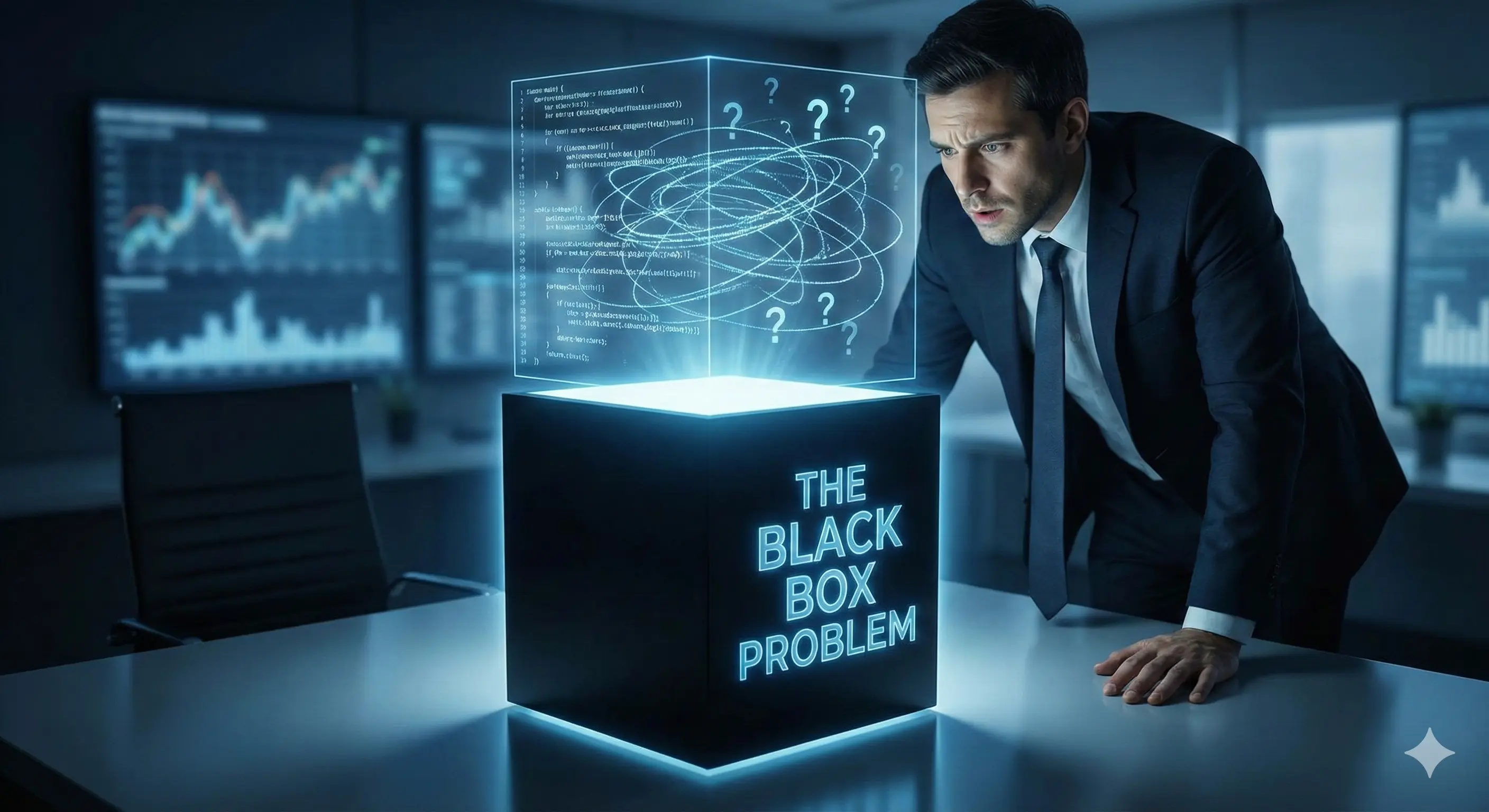
The "Black Box" Problem: Why We Don't Trust Manufactured Intelligence
We are currently living through a strange moment in history where we are handing over critical decision-making power to systems that we cannot fully explain. We ask a machine to summarize a legal contract, diagnose a patient, or approve a loan. It gives us an answer. The answer is often correct—startlingly so. But when we ask the machine, "Why did you make that decision?" it essentially stares back blankly.
This is the "Black Box" problem. And for anyone working in high-stakes fields like law, finance, or enterprise strategy, it is the single biggest barrier to adoption.
I have spent the last few years consulting with firms trying to integrate Large Language Models (LLMs) into their workflows. The excitement is always palpable in the demo phase. But the mood shifts the moment a General Counsel or a Chief Risk Officer enters the room. They don't care about the poetry the bot can write. They care about lineage. They care about audit trails. And right now, "It’s a probabilistic matrix of floating-point numbers" is not an answer that holds up in court.
What is the Black Box? (And Why Now?)
To understand why this is a crisis, you have to understand how software used to work. For the last 50 years, code was deterministic. If A, then B. A human programmer wrote a rule. If you wanted to know why the software denied a transaction, you could open the code and point to line 402: "If account_balance < 0, return FALSE."
Modern Generative AI, specifically the models built by companies like Anthropic, OpenAI, and Google, does not work like that. These systems are not programmed; they are trained. They digest billions of parameters and form their own internal representations of how language and logic connect. We know the input (the prompt) and we see the output (the answer), but the messy middle—the billions of neuron activations that lead from A to B—is largely opaque, even to the engineers who built it.
In real workflows, teams notice a disturbing trend: the "Confidence-Accuracy Gap." One issue that keeps coming up is that the model sounds most authoritative when it is hallucinating. I recently worked with a legal team testing a tool for case law research. The AI cited a precedent with perfect formatting, correct dates, and a plausible-sounding judge's name. It looked 100% real. It took a paralegal 45 minutes to realize the case didn't exist. The Black Box didn't "lie" in the human sense; it just completed a pattern. But because we couldn't see its reasoning process, we trusted the surface-level polish.
The Legal Frontier: Anthropic and the Quest for Transparency
This is where the conversation turns to specific tools. While GPT-4 grabs headlines for creativity, Anthropic has carved out a niche that is arguably more important for business: Interpretability and Safety. Their focus on "Constitutional AI" and recent breakthroughs in "dictionary learning" (mapping internal neuron patterns to human concepts) makes them the primary player in solving the Black Box.
Anthropic's approach to legal AI isn't just about having a chatbot that passed the Bar Exam. It is about creating a system that can cite its sources without making them up. Unlike standard models that predict the next word based on probability, Anthropic’s Claude (specifically the Opus and Sonnet variants) is designed with a larger "context window" and stricter guardrails against fabrication. It treats legal documents not just as text to be predicted, but as data to be retrieved and synthesized.
How It Works in Practice
When you use a high-end legal analysis tool powered by these models, the workflow is distinct from a Google search:
- Ingestion: You upload 50 PDFs of discovery documents (contracts, emails, depositions).
- Vectorization: The model converts these documents into a mathematical space, grouping similar concepts (e.g., "breach of contract" and "failure to deliver" get clustered together).
- Retrieval (RAG): When you ask a question, the system first hunts for the exact paragraphs in your documents that contain the answer.
- Synthesis: The LLM writes an answer only using the information it found in step 3.
This "Retrieval Augmented Generation" (RAG) is the current industry standard for cracking the Black Box. It forces the model to show its work.
Where This Breaks Down in Real Use
However, we need to be realistic. Even with RAG and "Constitutional AI," the Black Box isn't fully transparent yet. It's just translucent.
This sounds efficient, but in practice, the "reasoning" is still alien. I’ve seen seasoned attorneys get frustrated when they ask the AI to "flag all risky clauses." The AI might flag a standard liability clause as "risky" because its training data included aggressive negotiation blogs, while missing a subtle but devastating IP ownership loophole because the phrasing was slightly non-standard. The AI doesn't understand risk; it understands the semantic proximity of words associated with risk. Those are two very different things.
Another major failure point is nuance blindness. In a recent audit of an automated compliance tool, the system flagged an email as "potential insider trading" because an executive used the phrase "this is going to blow up." A human knows that in context, he was talking about a marketing campaign going viral. The Black Box saw a pattern match for market volatility and triggered a false alarm. If you rely on this blindly, you waste legal hours chasing ghosts.
Case Study: The Contract Review bottleneck
Let’s look at a mid-sized corporate law firm (let’s call them "Firm X") that tried to automate their NDA review process.
- The Goal: Reduce junior associate time spent on reviewing standard Non-Disclosure Agreements by 80%.
- The Setup: They used a customized instance of Claude 3, integrated via API, with a strict prompt to identify 5 key deal-breaker clauses.
- The Result: Initially, it was a disaster. The AI was too agreeable. If a counter-party wrote a clause that sounded polite but stripped Firm X of all rights, the AI often let it slide.
- The Pivot: They stopped asking the AI to "approve" contracts. Instead, they changed the prompt to "act as a paranoid defense attorney and list every worst-case scenario for this text."
- The Outcome: The tool became useful. It didn't make decisions; it generated a "paranoid summary" that a human associate could review in 5 minutes. The Black Box was useful as a devil's advocate, not a judge.
Comparison: Traditional Legal Tech vs. AI Models
It is crucial to understand that LLMs are not just "faster" versions of the old keyword search tools. They are fundamentally different beasts.
| Feature | Traditional Keyword Search (e.g., Ctrl+F) | Generative AI (e.g., Claude/GPT-4) |
|---|---|---|
| Mechanism | Exact string matching | Semantic concept matching |
| Transparency | 100% Transparent (White Box) | Low Transparency (Black Box) |
| False Positives | Low (If the word is there, it's there) | High (Can hallucinate connections) |
| Creativity | None | High (Can draft new text) |
| Trust Level | High reliability, low intelligence | Low reliability, high intelligence |
Who Should NOT Use This Tool
Despite the hype, the Black Box is currently dangerous for certain users. You should strictly avoid relying on generative AI if:
- You are pro se litigant: If you are representing yourself in court and cannot verify the case law the AI gives you, do not use it. There are already documented cases of judges sanctioning lawyers for submitting AI-generated fake citations.
- You need a guaranteed audit trail: In highly regulated finance sectors (like determining creditworthiness), you often need to explain exactly which variable caused a rejection. "The neural network didn't like the vibe of the application" is a compliance violation.
- You are dealing with handwritten or messy text: While OCR is getting better, LLMs still struggle to accurately interpret messy, unstructured handwritten notes compared to specialized legacy tools.
The "Explainability" Future
The industry knows the Black Box is a problem. That is why the next battleground isn't "who has the smartest model," but "who has the most explainable model."
Anthropic and others are working on "mechanistic interpretability." Imagine being able to perform an MRI on an AI. Instead of just seeing the output, you could see which neurons lit up. You could see that the AI associated "Project X" with "Confidential" because of a specific email in the training set. Once we have that, the Black Box becomes a Glass Box.
Until then, we have to operate with "trust, but verify." Actually, scratch that. Don't trust, and verify everything.
FAQ: Navigating the Black Box
Can we ever fully remove the Black Box?
Likely not with deep learning. The complexity that makes these models smart is the same complexity that makes them opaque. If we simplified them enough to be fully understandable by humans, they would cease to be intelligent.
Is Anthropic's Claude safer than ChatGPT?
In a corporate context, many argue yes. Anthropic's "Constitutional AI" training method is explicitly designed to reduce harmful or hallucinated outputs, making it a preferred choice for legal and enterprise integration, though no model is immune to errors.
Does using RAG solve the hallucination problem?
It mitigates it, but doesn't solve it. The AI can still misinterpret the documents you feed it. It won't invent facts from thin air (external hallucinations), but it might misread the facts you gave it (internal hallucinations).
Should I tell my clients I use AI?
Yes. Transparency builds trust. Hiding the use of a Black Box tool is a surefire way to destroy a client relationship if an error slips through.
How do I audit an AI decision?
Currently, the best audit is "evals"—running the model against a "golden set" of questions with known correct answers and measuring its accuracy rate over time. You audit the performance, not the thought process.
The Takeaway
The Black Box problem is not going away. As these models get larger, they will likely get more opaque, not less. But that doesn't mean we can't use them.
The key is to change how we view them. Do not view AI as an oracle of truth. View it as a highly widely-read, incredibly fast, but slightly drunk intern. You would give that intern the grunt work of summarizing 10,000 pages. You would let them draft the first version of an email. But you would never, ever let them sign the final contract without checking their work.
We don't need to fully understand the Black Box to use it. We just need to respect it enough not to turn our backs on it.
About the Author: Albert is a tech analyst and enterprise systems strategist covering the intersection of AI safety, legal automation, and corporate governance. He specializes in helping firms navigate the risks of deploying "Black Box" technologies.
Disclaimer: This article is for informational and educational purposes only. It does not constitute legal or financial advice. The use of AI in professional settings requires human oversight and verification.