NVIDIA H100 vs. Blackwell: Understanding the Chips That Run the World
If you have been near a data center procurement meeting in the last eighteen months, you know the atmosphere. It is frantic. The NVIDIA H100 "Hopper" has been the undisputed king of high-performance computing (HPC) and massive matrix workloads since its arrival. It became the currency of the modern tech economy.
But the tech cycle waits for no one. Enter Blackwell—specifically the B200 and the GB200 superchip. NVIDIA promises this is not just an iterative update but a fundamental shift in how we approach computational density.
So, is the H100 obsolete? Is Blackwell actually available in volumes that matter to anyone outside the "Magnificent Seven" companies? And critically, if you are sitting on a cluster of Hoppers, do you need to rip and replace?
I have spent years analyzing semiconductor supply chains and HPC infrastructure, and the answer is rarely as simple as looking at a TFLOPS chart. Let’s break down the silicon reality.
The H100: The Current Workhorse
To understand the leap Blackwell represents, we have to respect the baseline. The H100 introduced the Transformer Engine, which was a clever marketing term for dynamic precision handling—automatically switching between FP8 and FP16 to maximize throughput without destroying accuracy.
For most enterprise workloads today, the H100 is still overkill. It effectively solved the memory bandwidth bottleneck that plagued the A100 by utilizing HBM3 memory. When we deploy H100s, the conversation usually isn't about whether the chip is fast enough; it's about whether the facility can actually cool the rack.
In real workflows, teams notice that the theoretical max performance of an H100 cluster is rarely the number you see on the dashboard. The bottleneck has shifted away from pure compute (FLOPs) to interconnect latency. You can have the fastest chips in the world, but if they are waiting on data from a neighbor node, they are just expensive space heaters. This is where the H100 shines compared to previous generations, but it is also where Blackwell aims to kill it.
Enter Blackwell: The B200 and GB200
Blackwell is NVIDIA admitting that we have hit the reticle limit—the physical size limit of a single monolithic die achievable with current lithography. The B200 is effectively two massive silicon dies tied together with a 10 TB/s interface, tricking the software into thinking it's a single chip.
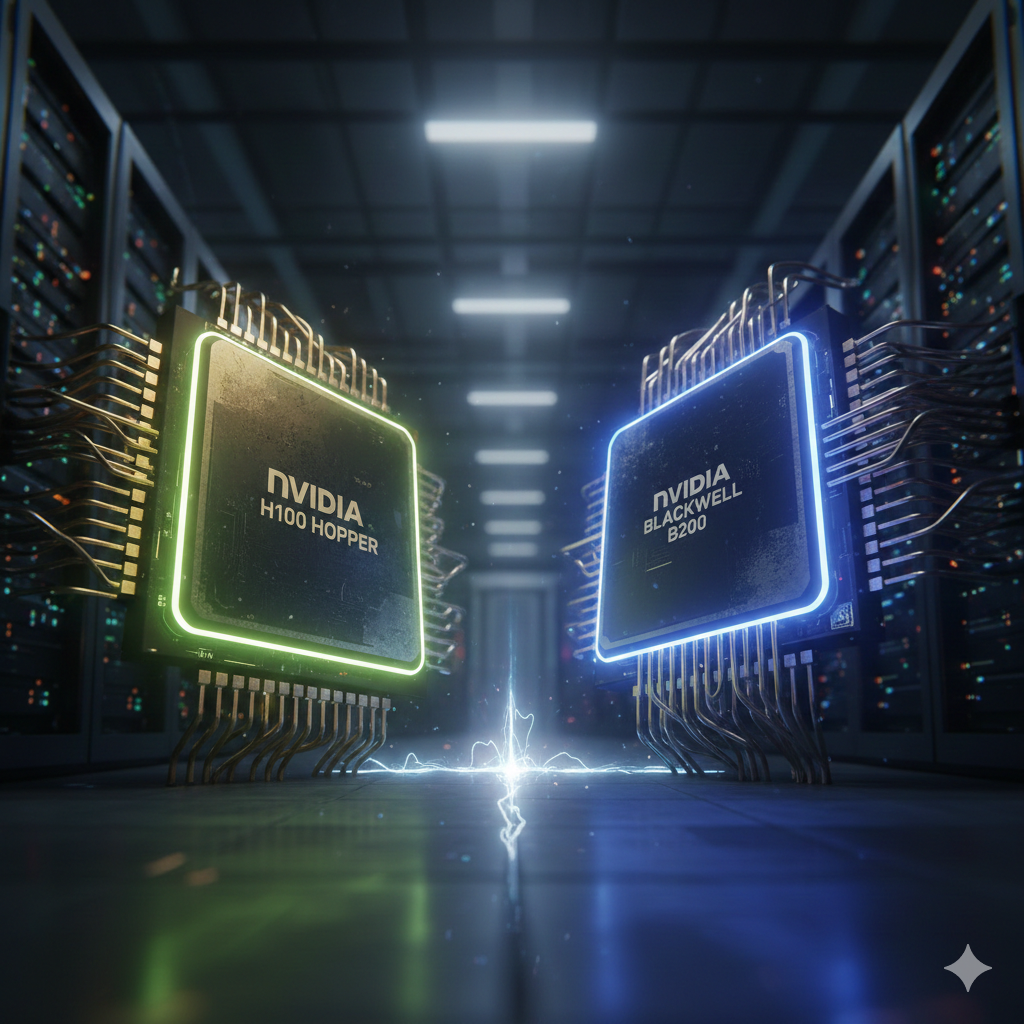
Here is the breakdown of the generational leap:
| Feature | NVIDIA H100 (Hopper) | NVIDIA B200 (Blackwell) |
|---|---|---|
| Architecture | Monolithic Die (4nm) | Multi-Die Chiplet (4NP) |
| Memory (HBM) | 80GB HBM3 | 192GB HBM3e |
| Memory Bandwidth | 3.35 TB/s | 8 TB/s |
| FP4 Tensor Core | Not Supported | Supported (20 PFLOPS) |
| Interconnect (NVLink) | 900 GB/s | 1.8 TB/s |
| Max TDP | 700W | 1000W+ (Air cooling becomes difficult) |
The FP4 Game Changer
The biggest number on that chart isn't the memory—it's the FP4 support. Blackwell introduces support for 4-bit floating-point math. In plain English, this means the chip can process data with lower precision to double the speed, relying on advanced logic to ensure the final output remains accurate.
This is risky for some scientific workloads, but for the vast majority of inference tasks (running models rather than training them), FP4 is the holy grail. It effectively doubles throughput without doubling power draw.
Real-World Friction: Where This Breaks Down
This sounds efficient, but in practice, migrating to Blackwell isn't plug-and-play. The power density is the elephant in the server room.
A standard H100 rack already pushes the limits of legacy air-cooled data centers, often requiring 30-40kW per rack. The Blackwell GB200 NVL72—a full rack solution—is designed as a liquid-cooled native architecture. It essentially behaves as one giant GPU.
One issue that keeps coming up is that facilities managers are looking at Blackwell specs and realizing their current buildings simply cannot support it. You aren't just buying a chip; you are likely retrofitting your cooling loop. If your data center relies on standard HVAC and forced air, Blackwell is going to be a nightmare to deploy at scale. The GB200 racks can draw upwards of 120kW. That is not IT infrastructure; that is heavy industrial power draw.
Who Should NOT Buy Blackwell?
It is easy to get caught up in the FOMO, but Blackwell is not for everyone. You should stick with H100s (or even A100s) if:
- You run high-precision scientific simulations: If your workload requires strict FP64 (double precision) for weather modeling or fluid dynamics, the FP4 magic of Blackwell is useless to you. The H100 is still a beast here.
- Your facility is air-cooled only: Unless you are ready for a massive CapEx spend on rear-door heat exchangers or direct-to-chip liquid cooling, the B200 is going to thermally throttle immediately.
- You are doing small-scale fine-tuning: If you are a mid-sized enterprise fine-tuning open-source models on internal data, the H100 offers better availability and a more mature software ecosystem right now.
The Cost of Ownership Argument
NVIDIA’s CEO Jensen Huang likes to say that 'the more you buy, the more you save.' The logic is that because Blackwell is roughly 2.5x to 5x faster at certain tasks than Hopper, you need fewer GPUs to do the same work.
This is mathematically true but operationally complex. Buying fewer GPUs saves on hardware, but the density increases the complexity of the networking (InfiniBand/Ethernet) and the storage required to feed them. A Blackwell GPU that sits idle because the storage array can't feed it data fast enough is a massive waste of capital.
What This Tool Gets Wrong: The 'Superchip' Hype
NVIDIA markets the GB200 (the combination of a Grace CPU and Blackwell GPUs) as the ultimate solution. However, this locks you heavily into the NVIDIA architecture, specifically the ARM-based Grace CPU.
For shops that are heavily optimized for x86 (Intel/AMD) CPUs due to legacy codebases or specific licensing constraints, the GB200 presents a friction point. You can't just slide it into an existing x86 chassis. It requires a commitment to the full NVIDIA stack. For many CIOs, that vendor lock-in is a terrifying proposition, regardless of the speed.
Case Study: The Inference Cost Curve
Let's look at a mid-sized tech company running a customer support bot (a standard RAG workflow).
Running this on a cluster of H100s is expensive. The chips are power-hungry, and you are often utilizing only 30-40% of the compute capacity because the memory bandwidth holds you back.
Moving this workload to Blackwell utilizing FP4 precision changes the economics. Early benchmarks suggest that for 'token generation' (creating the text response), Blackwell can reduce energy consumption by up to 25x compared to H100 if the model is optimized for 4-bit logic. For a company spending $5M a year on inference compute, that is not a spec upgrade; that is a profitability upgrade.
FAQ: Hopper vs. Blackwell
Is the H100 going to be discontinued?
No. The H100 (and the H200 refresh) will remain the volume product for a long time. Blackwell production capacity is limited by CoWoS (Chip-on-Wafer-on-Substrate) packaging supply. Most B200s are likely allocated to hyperscalers (Azure, AWS, Google) for the next 12 months.
Can I mix H100 and B200 in the same cluster?
Technically, yes, over a standard network. But you cannot link them via NVLink for a unified memory space. They are best kept as separate islands of compute.
Why is Blackwell using two dies?
Light physics. We can't easily print chips larger than the H100 due to the size of the reticle (the template used in lithography). To get bigger, NVIDIA had to print two chips and glue them together with extreme precision.
The Verdict
The H100 remains the reliable, available (mostly), and understood standard for high-performance computing. It is the safe bet for 90% of enterprises entering the space today.
Blackwell is the future, designed for the few organizations that are trying to build models larger than anything currently in existence. It is a marvel of engineering, but it demands a data center built to accommodate its thirst for power and cooling. Before you place that pre-order, call your facilities manager. They might just save you a few million dollars.
Disclaimer: This article is for informational purposes only. It does not constitute financial or investment advice. Technical specifications are based on public manufacturer data available at the time of writing.